
Every weekday in Fort Worth a driveway carries the family cars, the trash bins and the occasional delivery truck, then sits through months of hard sun and a few nights of ice. Concrete Commandos Fort Worth replaces and builds residential driveways with that whole year in mind, starting with the clay under the slab and the city rules at the curb.
What sits under a Fort Worth driveway
Large parts of Dallas and Tarrant counties sit on the Eagle Ford, whose weathered soil locals call "black gumbo." It contains bentonite, a clay that can swell or contract by as much as seven inches as it gains and loses water, which is hard on roads and foundations[1]. Clays like this expand when wet and shrink when dry[2], so a driveway here is only as steady as the moisture under it.
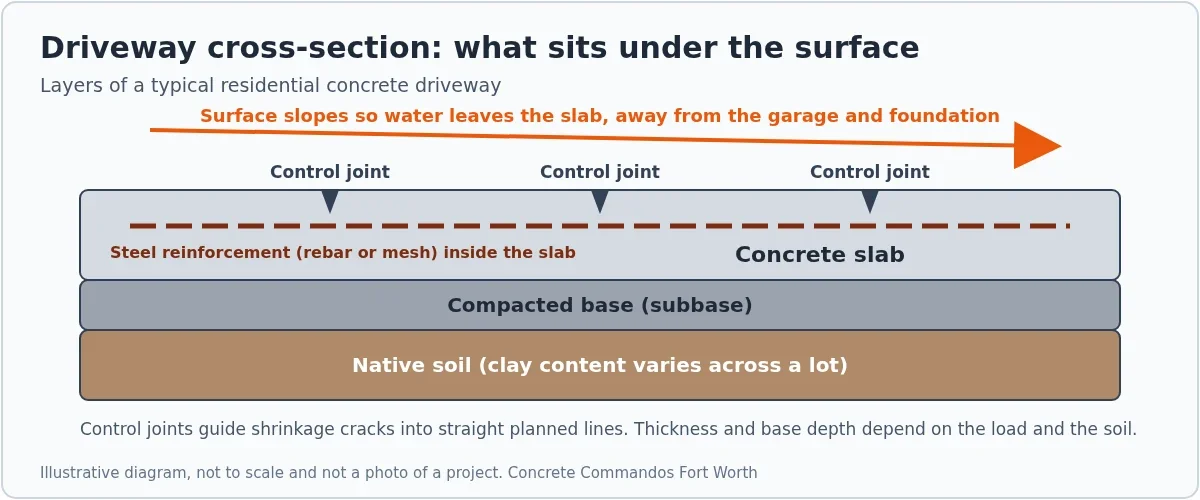
- Keep water moving: the slab is pitched so rain runs to the street or a planned outlet, not toward the garage or into a flower bed beside the slab.
- Build a steady base: soft or organic soil comes out, and the base is compacted in lifts so the slab bears on something uniform.
- Tie it together: steel reinforcement and sawed or tooled joints are laid out before the pour, so the cracks that clay movement causes land where they are expected[3].
Your slab and the city approach are separate jobs
The City of Fort Worth treats the part of the driveway on your lot differently from the part between the property line and the street. It says flatwork on your own property does not need a permit, while new or repaired drive approaches and sidewalks require parkway permits pulled by a bonded contractor[4]. Its parkway standards also set approach widths: 11 to 15 feet for no garage or a one car garage, 18 to 24 feet for a two car garage, and a 28 foot maximum for three cars or more[5].
A few more parkway details often come up on older Northside streets and infill lots. Approaches outside new subdivisions need site plan review, which the city says can take 7 to 10 business days, and approaches on corner lots must sit at least 30 feet from the intersecting street's curb face[5]. We sort out which pieces need a permit before a date goes on the calendar.
Summer pours and winter ice
National Weather Service normals for Dallas/Fort Worth average about 20 days a year at 100 degrees or hotter and about 29 nights at or below freezing[6]. Both matter. Heat makes concrete set faster, raises water demand and speeds evaporation, which can cause early shrinkage cracks unless the pour is planned and cured carefully[[CIP12]]. Freeze and thaw cycles, made worse by deicing chemicals, cause surface scaling, and air-entrained concrete is the standard defense where freezing and deicers are expected[[CIP2]].
- In July and August we favor early starts and curing that keeps the surface from drying out.
- On a new driveway, skip rock salt and other deicers the first winter and use sand for traction instead.
Driveway work we quote
- Tear-out and replacement of a heaved, sunken or broken slab, including haul-off.
- Widening for another car, tied to the old slab with a doweled or planned joint.
- Parking pads beside the garage or along an alley.
- New driveways on new homes and infill lots, coordinated with the builder.
Finish choices include a plain broom texture for grip, exposed aggregate, color, and stamped borders. A walk that leaves the driveway for the front door is easy to add in the same pour, see walkways and sidewalks.
How the price is built
We do not post a per-square-foot price, because the same footprint can cost very different amounts. Your written estimate breaks out the items that change the number: area and shape, slab thickness and steel, demolition and disposal, base repair, the finish, and any approach or sidewalk work that needs a parkway permit. Cracked slabs that are still sound can sometimes be handled through repair instead.
Driveway questions from Fort Worth homeowners
Does Fort Worth require a permit to replace my driveway?
The city says driveway flatwork on your own property does not need a permit. The approach and the public sidewalk are different: new or repaired approaches and sidewalks need parkway permits pulled by a bonded contractor.
How wide can a driveway approach be in Fort Worth?
The city parkway standards list 11 to 15 feet for no garage or a one car garage, 18 to 24 feet for a two car garage and a maximum of 28 feet for three cars or more.
Can I use ice melt on a new driveway?
Deicing chemicals make freeze and thaw scaling worse, and new concrete is most vulnerable. Use sand for traction the first winter and keep salts to a minimum after that.
Why do Fort Worth driveways heave and crack?
Clay soils swell when they get wet and shrink as they dry, and the Eagle Ford clays common in Tarrant County can move a lot. Drainage, a good base, reinforcement and planned joints keep that movement under control.
How soon can I park on it?
Walking is usually fine after a day or two. Most cars wait about a week, and heavier vehicles longer, depending on weather and the mix.
Driveways near Fort Worth
Driveways are a big part of our work across Tarrant County. Each city page explains the local permit steps: