
On many Fort Worth streets the walk from the curb to the porch is older than the people using it, and it shows: tipped panels, root bumps and steps with uneven risers. Concrete Commandos Fort Worth replaces front walks, side paths and steps, and builds new ones to connect driveways, gates and back patios.
Private walk or public sidewalk?
It makes a difference who owns the strip you want replaced. The City of Fort Worth says new or repaired sidewalks and drive approaches need parkway permits pulled by a bonded contractor, while flatwork on your own property does not need a permit[1].
Laying out a walk people actually use
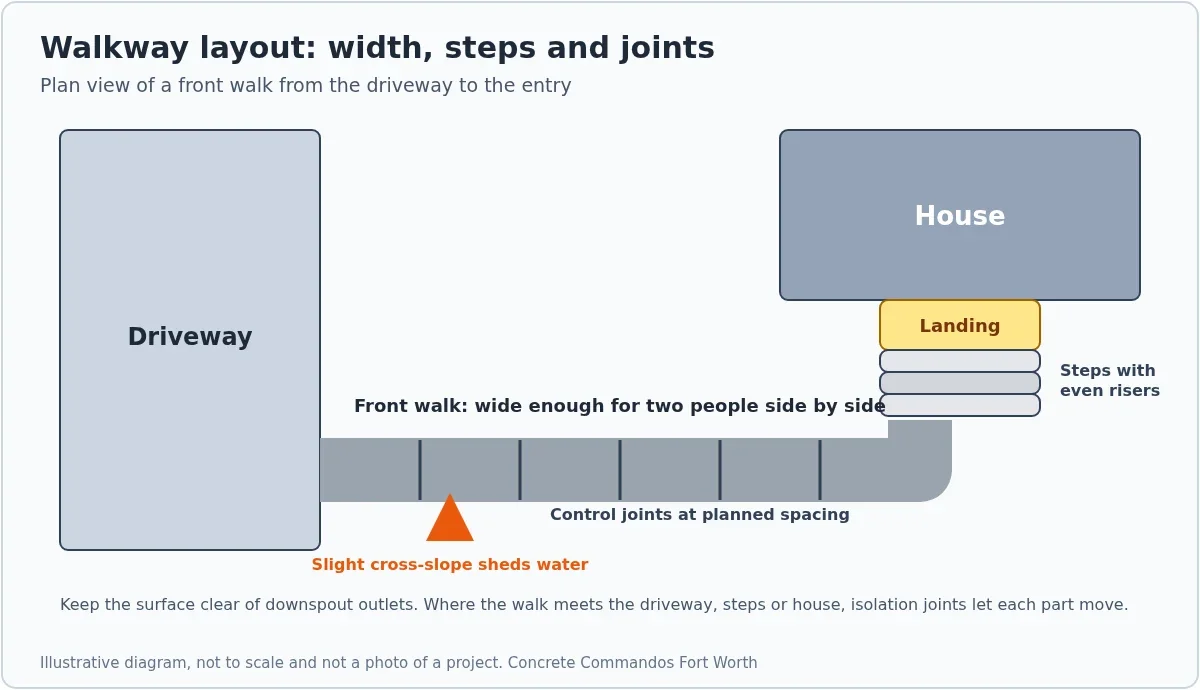
- Follow the natural path: people cut corners, so curves and direct routes beat a walk nobody uses.
- Width: wide enough for two people or a stroller at the front entry; narrower is fine for side yards.
- Steps: even risers and a landing at the door; handrails where height and code call for them.
- Cross-slope: a slight tilt so rain runs off instead of sitting in the middle.
Walks on clay soil
Thin walks feel ground movement first. Clay that swells when wet and shrinks when dry[2] tips panels at the joints, so we compact the base, set joints at regular spacing to guide shrinkage cracks[3] and keep downspouts from emptying onto the walk. Where a tree root has lifted a panel, we talk about options before cutting anything.
Ice and traction
The Dallas/Fort Worth area averages about 29 nights a year at or below freezing[4]. A broom finish gives the best grip when a walk is wet or frosty. Deicing salts speed up freeze and thaw scaling[[CIP2]], so sand is the safer choice on a new walk.
Permits in nearby cities
Rules change at the city line. Haltom City lets walks, platforms and decks that rise 6 inches or less off the ground go without a permit[5]. In North Richland Hills, a small slab of less than 200 square feet skips the permit only if it meets a list of conditions, one being that it stays off public right-of-way[6]. See the Haltom City and River Oaks pages for local contacts.
Pairing a walk with other work
A new walk is easiest to add when the driveway or patio is being poured, and a stamped border can tie them together. Raised or sunken panels may be candidates for repair rather than replacement.
Walkway and sidewalk questions
Do I need a permit to replace the sidewalk in front of my Fort Worth house?
If it is the public sidewalk, yes: the city requires a parkway permit pulled by a bonded contractor. A private walk on your lot does not need a permit.
How wide should a front walk be?
Wide enough for two people side by side at the main entry is a comfortable target. Side paths can be narrower.
Why do walk panels tip at the joints?
Clay movement, a weak base and roots are the usual causes. Fixing drainage and the base keeps a new walk flatter.
What finish is safest on steps?
A broom finish gives the most grip when wet or icy. Stamped or smooth finishes are better kept to flat areas.
Walkway service area
We pour walks and sidewalks in Fort Worth and nearby cities: