
When a Fort Worth slab cracks, sinks or flakes, the first question is why. Concrete Commandos Fort Worth looks at the cause as well as the damage, then tells you plainly whether a repair will hold or whether the slab should be replaced.
The usual causes in Tarrant County
- Clay movement: Eagle Ford clays found across Dallas and Tarrant counties contain bentonite that can swell or contract by inches as moisture changes[1]. Slabs lift in wet seasons and drop in droughts.
- Washed-out base: a gutter, a leaking irrigation line or water running under a slab edge removes the support underneath.
- Freeze and thaw: the Dallas/Fort Worth area averages about 29 nights a year at or below freezing[2]. Saturated concrete that freezes, especially with deicers, can scale and flake[[CIP2]].
- Roots: trees close to a walk or driveway push panels up.
- Age and finish: older slabs placed without joints or air entrainment wear faster.
Matching the fix to the damage
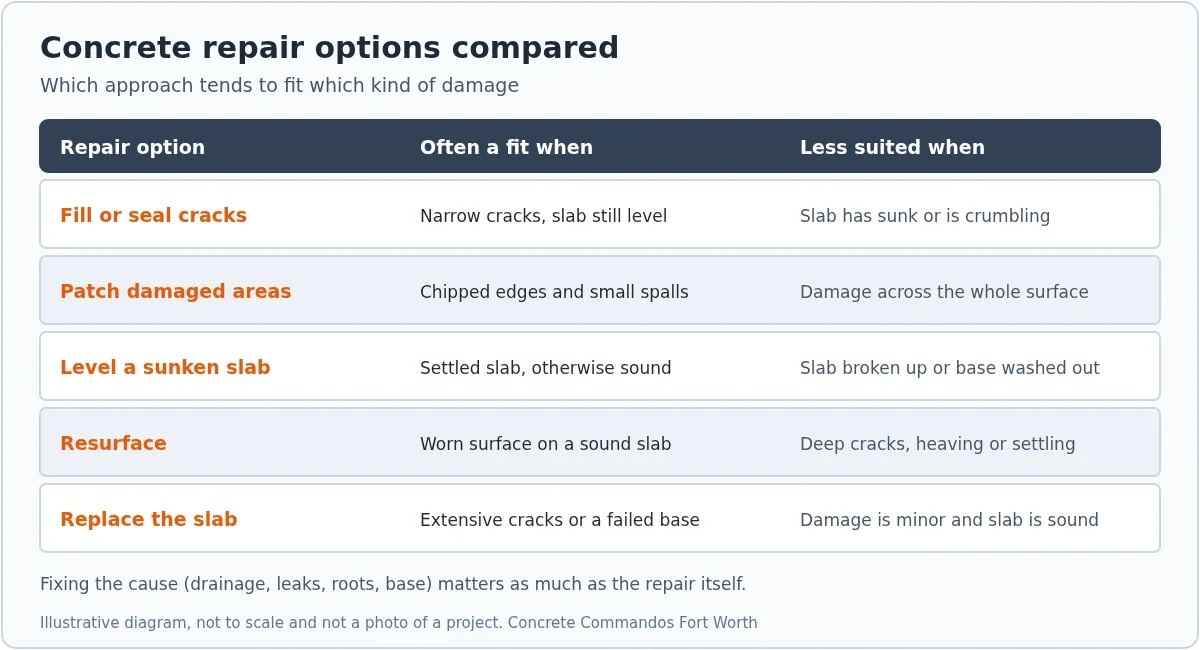
- Seal cracks when they are narrow and the slab is still level, to keep water out of the base.
- Patch chipped edges and small spalls.
- Lift a sunken panel when it is intact but has dropped, often at a driveway apron or a walk joint.
- Resurface a slab that is sound but scaled or stained.
- Replace sections that are broken through, heaved badly or sitting on a failed base.
Fix the water first
Most repairs fail because the water problem stays. We check where downspouts empty, whether sprinklers hit the slab edge and whether the soil slopes back toward the concrete. Correcting those is often the cheapest part of the job and the one that keeps cracks from coming back.
When replacement is the better value
If more than a few panels are broken or the slab has tipped toward the house, patching just delays the bill. Replacement lets us rebuild the base and add reinforcement and joints. See driveways, patios and walkways for what a new slab involves. In Fort Worth, replacing a public sidewalk panel or a drive approach needs a parkway permit pulled by a bonded contractor[3].
Keeping a repaired slab healthy
Keep gutters clean and extended, water foundations and slab edges evenly in drought instead of letting soil crack open, and use sand instead of salt on ice. A sealer on driveways and walks slows water getting into the surface.
Repair questions
Is a hairline crack a problem?
Usually not structurally. Sealing it keeps water out of the base, which is what turns small cracks into big ones.
Why does my driveway crack more in summer?
Clay soil shrinks as it dries in hot, dry spells, and slabs can lose support at the edges. Wet seasons can lift them again.
What causes flaking on the surface?
Freeze and thaw scaling is common, especially where deicers were used or the concrete was not air-entrained or was finished too wet.
Can a sunken sidewalk panel be fixed without replacing it?
If the panel is intact, it can often be lifted back to grade. If it is broken, replacement is usually better. Public sidewalks in Fort Worth need a parkway permit.
Repair service area
We repair concrete in Fort Worth and these cities: