
In Fort Worth, a backyard patio gets most of its use in spring and fall evenings, and it has to survive the months in between. Concrete Commandos Fort Worth pours patios on clay soil, in triple-digit heat and through the odd winter freeze, and we design the slab around shade, drainage and how far the grill sits from the back door.
Start with how the yard drains
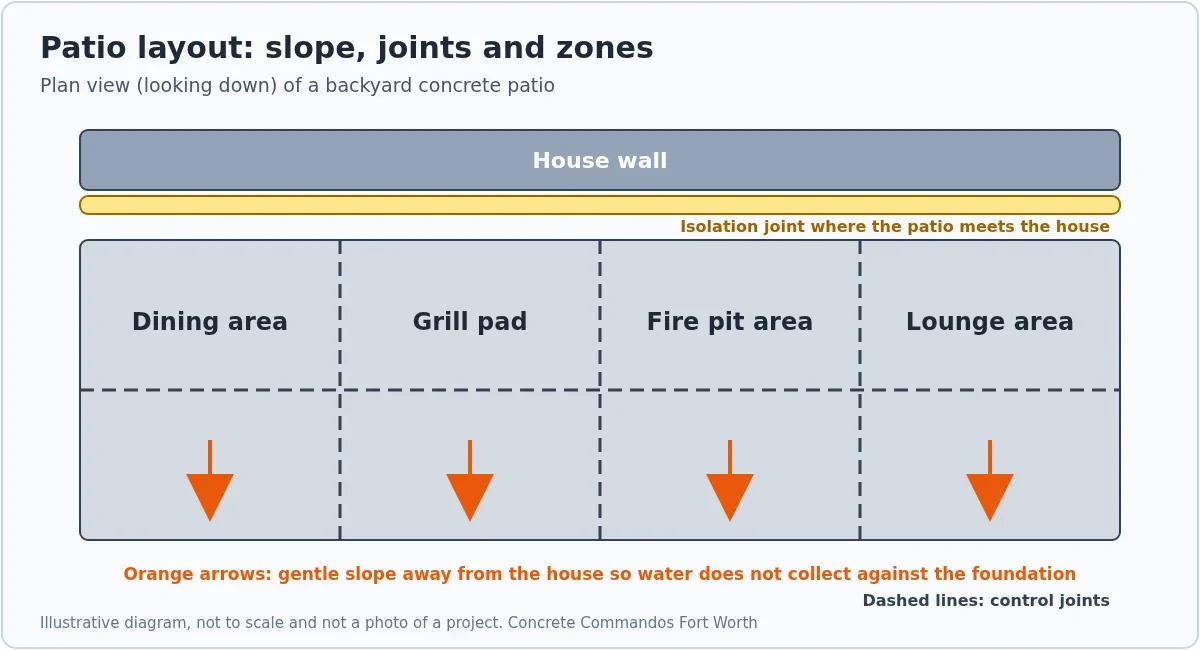
Most older Fort Worth lots were graded decades ago, and many backyards drain toward the house or toward a fence line that no longer lets water out. A patio adds a large hard surface, so it can make that worse or fix it. We pitch the slab away from the foundation, look at where downspouts empty and, when needed, add a swale or a drain so water has a clear route off the lot.
The ground matters as much as the slope. Tarrant County soils include expansive clays like the Eagle Ford "black gumbo," which can swell and shrink sharply as moisture changes[1]. A patio that stays evenly drained moves less, and joints placed at regular spacing keep shrinkage cracking in straight lines[2].
Sizing a patio for North Texas use
- Dining: leave room to pull chairs back from a table on all sides.
- Cooking: a grill or outdoor kitchen pad set away from siding and windows.
- Shade: a pergola or cover usually needs footings, so plan it before the pour.
- Fire pit: a separate zone with room to walk around it.
Heat, color and comfort
With about 20 days a year at or above 100 degrees in Dallas/Fort Worth[3], the surface temperature of a patio is a real design choice. Lighter colors and textured finishes stay more comfortable than dark, smooth ones. Heat also affects the pour itself: high temperatures and wind speed up setting and evaporation, so summer patios are scheduled early in the day and cured carefully[[CIP12]].
Finishes we pour
A broom finish is the most economical and gives grip. Exposed aggregate adds texture, integral color changes the tone through the whole slab, and stamped concrete imitates stone, slate or wood. Many homeowners pair a broom field with a smooth or stamped border.
Permits, covers and HOAs
The City of Fort Worth says flatwork on your own property does not require a permit[4], but a roof, pergola or outdoor kitchen with gas or electric lines is a different project, and so is anything in an easement. Newer neighborhoods in suburbs such as Keller and North Richland Hills often have an HOA that reviews backyard changes, and some cities there have their own flatwork rules, so ask before you finalize a plan.
Upgrading an old patio
Many Fort Worth homes came with a small slab at the back door. It can often be extended with a doweled joint, or removed and replaced if it has settled toward the house. If the slab is sound but tired, resurfacing or repair may be the cheaper path. Patios that meet a pool deck or a garden path look best when joints and finish line up.
Patio questions we hear in Fort Worth
Do I need a permit for a backyard patio in Fort Worth?
The city says flatwork on your own property does not require a permit. Covers, structures, gas or electrical work, and work in easements can be different, so check before you build.
Will a darker patio get too hot to walk on?
Dark, smooth surfaces absorb more heat. Lighter colors and textured finishes are usually more comfortable during Fort Worth summers.
Can you extend my small back porch slab?
Usually. New concrete is tied to the old slab with dowels or a planned joint. The two will not match perfectly in color, so many people add a border or replace the old section.
My yard drains toward the house. Can a patio help?
Often yes. A patio pitched away from the foundation, plus a swale or drain where needed, can give water a better path off the lot.
Patio service area
We pour patios in Fort Worth and these nearby cities: